TON Extends Losses: Underperforming the Broader Crypto Market as Investor Sentiment Weakens

Beginner
Quick Reads
Last Updated 2026-03-26 21:32:00
Reading Time: 1m
TON's downward trend has accelerated, sparking increased market attention. In comparison to leading cryptocurrencies such as Bitcoin, TON has experienced a notably steeper decline. This article examines the technical and fundamental drivers behind TON's performance, providing insights into its future trajectory for readers.

Recent TON Price Performance and Market Overview
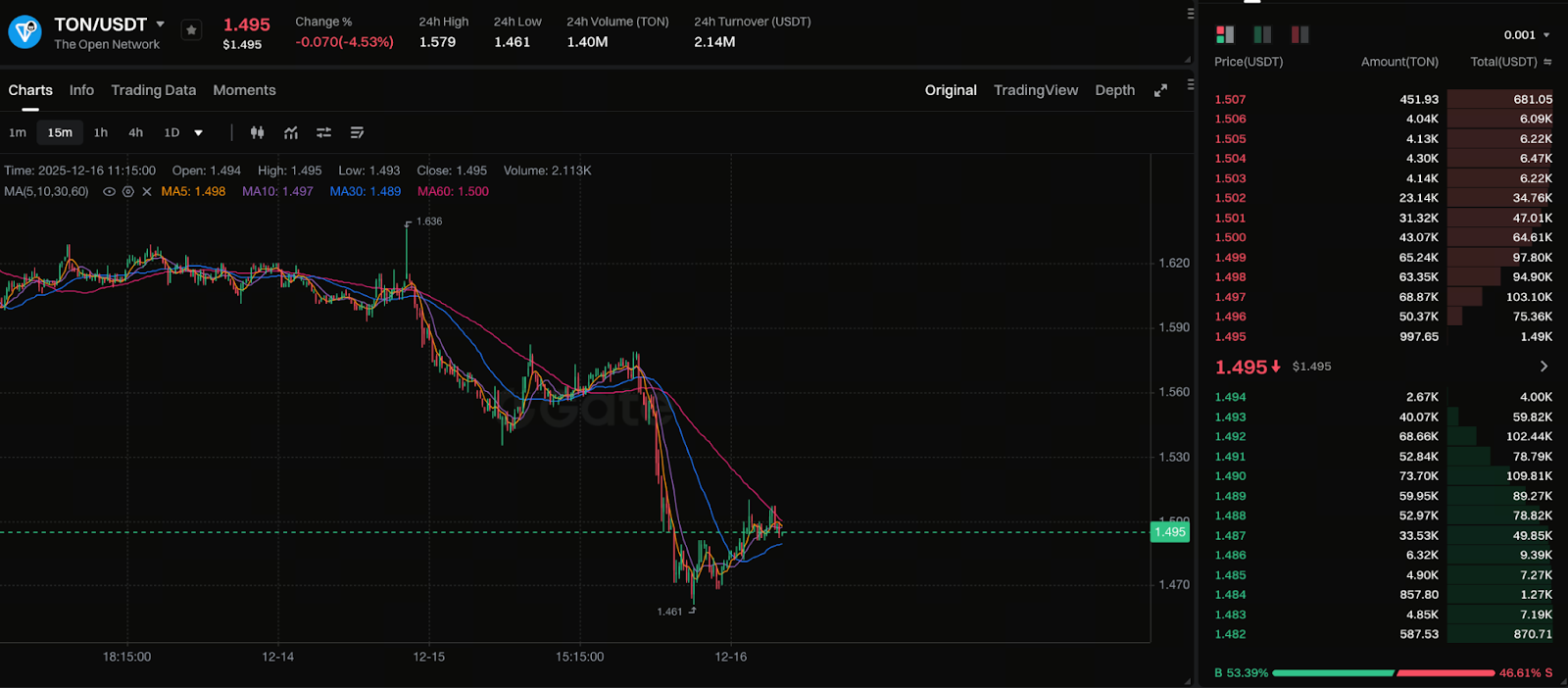

Chart: https://www.gate.com/trade/TON_USDT

Toncoin (TON), the native token of The Open Network, has consistently drawn significant market attention due to its close ties with the Telegram ecosystem. However, since Q4 2025, TON’s price has come under sustained pressure, consistently underperforming major cryptocurrencies.

Recently, TON has posted several notable declines. In certain trading sessions, TON’s daily losses have reached approximately 3%–4%. While the broader crypto market has also faced downward pressure during this period, leading assets have generally seen milder corrections, with some even showing brief signs of stabilization. This makes TON’s relative weakness especially pronounced in comparison to the broader market.

Market Comparison: TON Significantly Underperforms Leading Assets

Looking at the overall landscape, Bitcoin and Ethereum have mostly maintained a high-level consolidation pattern. Although they also face correction pressure amid macro uncertainty, their declines have generally remained contained within the 2%–4% range.

By contrast, TON’s declines have repeatedly outpaced the broader market during multiple periods, highlighting its heightened sensitivity to risk in the current environment. This underperformance is not a short-term anomaly but rather a persistent trend.

Primary Drivers Behind TON’s Leading Declines

1. Weak Technical Structure Remains Unresolved

From a technical perspective, TON continues to trade below several critical moving averages (including the MA-20 and MA-50), with both short- and medium-term trends remaining bearish. This downward technical alignment means that each rebound faces strong selling pressure, making it difficult to achieve a decisive trend reversal.

In this context, any broad market volatility tends to amplify TON’s declines, rather than allowing it to move in line with the overall market.

2. Defensive Market Sentiment and Reduced Risk Appetite

On the macro front, interest rate expectations, Federal Reserve policy uncertainty, and shifting global risk sentiment continue to weigh on overall crypto risk appetite. When the market turns defensive, capital typically exits more volatile and structurally weaker assets first.

As a non-BTC/ETH mainstream token, TON is more likely to be viewed as a higher-risk asset during such periods, resulting in additional selling pressure.

3. Amplification from Concentrated Token Holdings

TON’s token distribution is relatively concentrated, with large holders and whale addresses exerting a direct impact on short-term price action. When some major holders reduce their positions, the market often reacts rapidly with increased volatility.

In a tightening liquidity environment, this structural feature tends to accelerate short-term declines.

Market Sentiment and Short-Term Trend Analysis

Sentiment indicators suggest that the market remains cautious, with fear not yet fully dissipated. Even during localized rebounds, TON’s recovery has been noticeably weaker than the broader market, signaling that bullish confidence remains low.

This indicates that TON’s price action is shaped not only by overall market direction but also by its technical structure and capital dynamics. Until a significant trend reversal occurs, its volatility is likely to remain reactive and passive.

What Does This Mean for TON Investors?

For those holding or monitoring TON, the current widening price differential presents both risks and potential opportunities:

Risks

  • If TON continues to lag the broader market, its price may enter a prolonged consolidation or face another decline
  • If technical indicators fail to recover promptly, the short-term trend will remain unfavorable for bulls
  • Opaque behavior by large holders may amplify interim volatility

Potential Opportunities

  • If the macro environment improves and market risk appetite returns, TON’s oversold condition could provide greater rebound potential
  • If key support levels are effectively confirmed, the risk–reward profile may gradually improve
  • The long-term expansion of the Telegram ecosystem still offers fundamental growth potential for TON

Conclusion: Risks Require Vigilance, but Resilience Remains

Overall, TON’s recent underperformance relative to the broader crypto market results from a combination of weak technicals, bearish sentiment, and structural factors. In the short term, its price action will need time to restore confidence and technical strength.

However, from a broader perspective, TON’s current weakness does not necessarily negate its long-term potential. The key will be whether the future brings a combination of improving market conditions, technical stabilization, and renewed on-chain activity.

For investors, understanding the current risk structure is more important than simply betting on market direction.

Author: Max
Disclaimer
* The information is not intended to be and does not constitute financial advice or any other recommendation of any sort offered or endorsed by Gate.
* This article may not be reproduced, transmitted or copied without referencing Gate. Contravention is an infringement of Copyright Act and may be subject to legal action.

Related Articles

AI-Native Settlement Layers: How United Stables Is Building the Next Financial Rail
Beginner

AI-Native Settlement Layers: How United Stables Is Building the Next Financial Rail

Stablecoins were originally designed as dollar substitutes within exchanges, primarily used for asset pricing and trade settlement. As on-chain financial ecosystems have matured, their role has expanded beyond simple payments to include collateral assets, cross-chain liquidity mediums, and unified settlement units. In particular, as AI systems and automated agents begin to participate directly in economic activity, demand has risen sharply for programmable value units capable of instant settlement. This shift is pushing stablecoins toward the role of foundational financial infrastructure.
2026-03-25 03:16:17
The ve(3,3) Flywheel Explained: How AERO Tokenomics Powers Aerodrome’s DeFi Economy
Beginner

The ve(3,3) Flywheel Explained: How AERO Tokenomics Powers Aerodrome’s DeFi Economy

In the competition for DeFi liquidity, high-inflation mining alone is no longer enough to build lasting advantages. Aerodrome applies the ve(3,3) economic model to redesign token emissions, voting mechanisms, and revenue distribution, creating a liquidity flywheel centered on governance and cash flow. This article examines AERO tokenomics, the veAERO locking mechanism, and protocol revenue models to explain how Aerodrome builds a sustainable DeFi economic system.
2026-03-25 06:41:58
Aerodrome Tokenomics: How ve(3,3) Powers Base's Most Profitable DEX
Beginner

Aerodrome Tokenomics: How ve(3,3) Powers Base's Most Profitable DEX

AERO is the native token of Aerodrome Finance, a core decentralized exchange and liquidity protocol in the Base ecosystem. It is primarily used for liquidity incentives and ecosystem operations. veAERO is a governance NFT that users receive by locking AERO, representing both voting power and the right to share protocol revenue. Through a dual track structure of AERO as a utility token and veAERO as a governance credential, Aerodrome separates liquidity usage value from long term governance power, allowing participants to act as liquidity providers, governance decision makers, and revenue sharers within the same system.
2026-03-25 06:40:31
How is the price of PAXG determined? Pegging mechanism, trading depth, and influencing factors
Beginner

How is the price of PAXG determined? Pegging mechanism, trading depth, and influencing factors

PAXG (Pax Gold) is a tokenized asset backed by physical gold reserves, launched by fintech firm Paxos and issued as an ERC-20 token on the Ethereum blockchain. The core concept is to digitally represent real-world gold assets, allowing investors to hold and trade gold via the blockchain network. Because each PAXG token corresponds to a specific quantity of physical gold, its price is theoretically expected to closely track the global gold market.
2026-03-24 19:11:40
How Does PAXG Work? In-Depth Overview of the Physical Gold Tokenization Mechanism
Beginner

How Does PAXG Work? In-Depth Overview of the Physical Gold Tokenization Mechanism

PAXG (Pax Gold) is a tokenized asset backed by physical gold, issued by the fintech company Paxos and traded on the Ethereum blockchain as an ERC-20 token. The core concept is to tokenize physical gold on-chain, with each PAXG token representing ownership of a certain amount of gold. This structure enables investors to hold and trade gold in the form of a digital asset.
2026-03-24 19:12:51
Hybrid Collateral Stablecoins: Inside United Stables' Stability and Yield Architecture
Beginner

Hybrid Collateral Stablecoins: Inside United Stables' Stability and Yield Architecture

In the early stages of the crypto market, traditional stablecoins mainly relied on single-reserve or single-collateral models. Their primary focus was price stability and payment convenience, which allowed them to become foundational tools for on-chain trading and capital flows. As the market has entered a more mature financial phase, however, this structure has begun to reveal limitations, including high concentration risk and the difficulty of balancing liquidity with yield. These constraints have driven the evolution toward multi-layer collateral and portfolio-based designs, such as the dual-layer hybrid collateral architecture proposed by United Stables, which seeks to redefine the underlying logic of stable assets.
2026-03-25 03:17:39





